- News
Safer Work Zones: The Vital Role of Professional Traffic Details in Community Infrastructure
Modernizing civic infrastructure is essential to community prosperity. Across our cities and counties, utility providers, state departments of transportation, and commercial contractors work daily to upgrade water mains, repair bridges, expand broadband networks, and repave roadways.
Yet active roadway construction is inherently dangerous. Work zones present sudden lane merges, heavy equipment movement, uneven pavement, and workers operating within feet of high-speed traffic. Distracted driving, speeding, and driver confusion can turn a standard utility excavation into a hazardous environment within seconds.
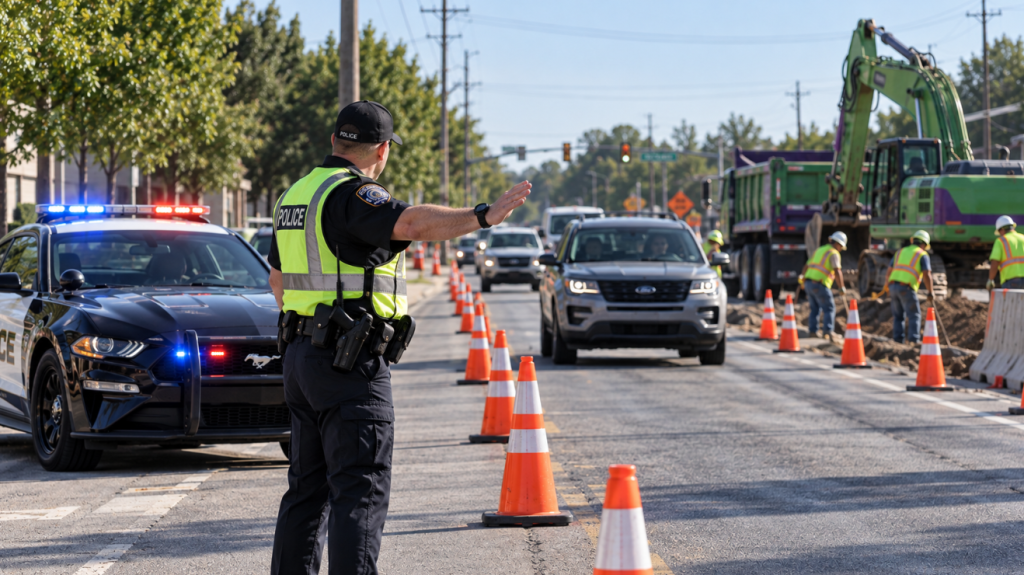
The presence of sworn law enforcement officers on traffic details and road construction jobs provides an irreplaceable layer of safety. Marked cruisers with emergency lighting and uniformed officers directing traffic slow motorists, deter hazardous maneuvers, and protect construction crews and pedestrians alike.
Maximizing the effectiveness of these details requires reliable coordination, rapid request turnaround, and seamless operational administration.
The Operational Impact of Police Presence in Work Zones
Studies and field experience consistently demonstrate that high-visibility police presence fundamentally alters driver behavior in roadway corridors:
- Significant Speed Reduction: Motorists react immediately to marked law enforcement cruisers and official emergency lighting. Placing marked units at advance warning points significantly reduces vehicle approach speeds through work zones.
- Active Traffic Deconfliction: Sworn officers possess the legal authority and specialized tactical training required to direct traffic at complex intersections, coordinate manual signal overrides, and safely guide heavy construction machinery across active thoroughfares.
- Immediate Incident Response: If a collision, disabled vehicle, or medical emergency occurs within a work zone, having an officer on scene ensures immediate tactical command, rapid EMS dispatch, and secondary crash prevention.
Coordination Challenges in Road Details
Despite the critical safety value of road jobs, coordinating traffic details internally often creates friction between municipal agencies, utility companies, and contractors:
- Last-Minute Scheduling Pressures: Infrastructure emergencies – such as water main breaks or storm-damaged power lines – require immediate, same-day detail coverage. Traditional police administration desks operating on standard 9-to-5 schedules struggle to fill sudden, off-hours requests.
- Weather-Related Cancellations: Asphalt paving and highway concrete operations are highly weather-dependent. Rain or equipment delays frequently force contractors to cancel or postpone shifts on short notice, leading to billing disputes over cancellation minimums and officer compensation.
- Cruiser and Equipment Allocation: Municipalities must ensure that marked cruisers assigned to road construction details are tracked accurately and that equipment usage fees are billed and recovered properly to support fleet maintenance.
Streamlining Traffic Detail Administration
Modern third-party administration helps eliminate coordination challenges by serving as an operational bridge between construction contractors, municipal public works departments, and public safety personnel.
Contractor Initiates the Detail
- Submits the request through a 24/7 service center or online portal.
- Provides the specific worksite location and lane closure requirements.
- Confirms marked cruiser and equipment needs.
Automated Dispatch and Assignment
- The detail is broadcast to eligible and qualified traffic officers.
- Seniority, CBA, and agency distribution rules are automatically applied.
- Rest periods and fatigue requirements are verified before an officer can accept the assignment.
Field Execution and Billing
- The officer checks in on-site through a GPS-enabled mobile app.
- The contractor digitally verifies completed shift hours.
- Officer payroll is processed according to the established payment schedule.
- Applicable cruiser or vehicle fees are remitted to the municipality.
With 24/7/365 administrative coverage, dedicated support teams can also manage late-night emergency requests, process short-notice weather cancellations according to department policy, and help ensure critical work-zone assignments remain properly staffed.
Building Stronger Relationships with the Business Community
When road details are managed smoothly, the relationship between local government and commercial contractors improves substantially:
- Predictable Scheduling: Infrastructure contractors can plan complex paving projects with confidence, knowing their traffic safety details will be staffed on time by qualified first responders.
- Clear Cancellation Protocols: Having an objective, third-party platform enforce established departmental cancellation policies prevents disputes over late cancellations and minimum hours.
- Equitable Cruising and Equipment Fees: Municipalities recover equipment wear-and-tear costs consistently, ensuring local taxpayers do not subsidize private utility operations.
Executive Key Takeaways
- High Visibility Saves Lives: Marked police units and uniformed officers significantly reduce motorist speeds and prevent fatal collisions in work zones.
- 24/7 Dispatch is Critical: Managing utility repairs and infrastructure emergencies requires an administrative operation center available around the clock.
- Consistent Equipment Recovery: Ensure vehicle usage and municipal apparatus fees are billed and recovered accurately from commercial contractors.
- Strengthen Community Infrastructure: Streamlining the detail booking process keeps civic construction projects on schedule while maintaining community safety.
Need to streamline traffic detail coordination for your upcoming infrastructure and utility projects? Contact Extra Duty Solutions today to learn how our 24/7 operation centers support municipal work zone safety.